 Project funded by France 2030
A ctDNA bioinformatics pipeline for precision oncology
Sycomia runs applied research on liquid biopsy: a multi-platform pipeline that analyzes circulating tumor DNA (ctDNA), at the intersection of genomics and artificial intelligence.
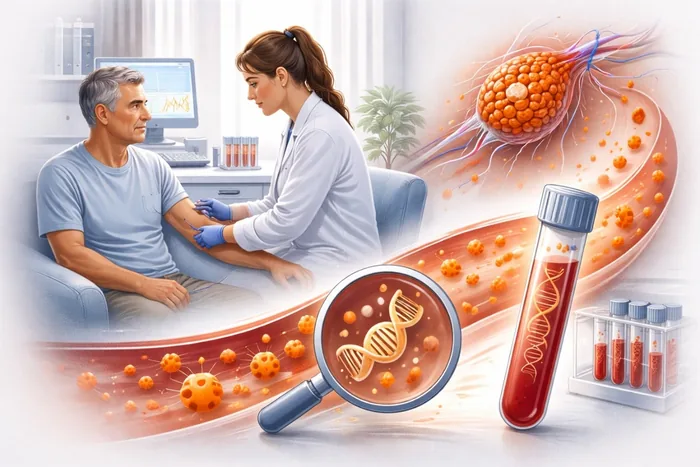
Why liquid biopsy?
Cancer remains one of the most pressing public health challenges of our time. While therapies keep improving, diagnosis and therapeutic monitoring still fall short: too invasive, too late and not informative enough at the molecular level. Conventional methods such as tumor biopsy or medical imaging cannot identify minimal residual disease, the small population of surviving tumor cells that signals an impending relapse.
Liquid biopsy changes the equation. By analyzing circulating tumor DNA from a simple blood draw, it becomes possible to:
-
Detect cancer earlier
Spot tumor signals in the blood at an earlier stage.
-
Monitor treatment response
Follow the response to treatment in real time, without a new tissue biopsy.
-
Anticipate relapse
Identify a relapse before it becomes clinically apparent.
Our ctDNA bioinformatics pipeline
A modular, containerized pipeline that natively integrates the three major sequencing technologies and an artificial intelligence layer, to turn raw data into clinically actionable results.
-
Blood sample
Plasma from a simple blood draw
-
Sequencing
Short reads and long reads
-
AI analysis
Multimodal signal fusion
-
Clinical report
Structured, actionable results
Three complementary sequencing technologies
-
Short reads + UMI
Illumina
Unique Molecular Identifiers for ultra-sensitive detection of point mutations.
-
Long reads
Oxford Nanopore
Direct detection of structural variants, gene fusions and chromosomal rearrangements, with native reading of DNA methylation.
-
Long reads
PacBio HiFi
Highly accurate long reads for structural variants and epigenetic modifications, read directly on the same molecules.
Artificial intelligence at every step
Long reads provide genomic and epigenomic information from the same molecules, a capability out of reach for single-technology approaches. Our AI models build on this to deliver:
- Multimodal signal fusion
- Better signal-to-noise discrimination in complex genomic regions
- Cancer classification with enhanced sensitivity
- Tissue-of-origin prediction
- Treatment efficacy assessment
What sets our approach apart
Current ctDNA solutions rely on a single technology and closed gene panels. Sycomia takes a fundamentally different approach: platform-agnostic, multi-technology and open.
| Current solutions | Our pipeline | |
|---|---|---|
| Sequencing | Short reads (Illumina) only | Illumina, Oxford Nanopore and PacBio HiFi |
| Targets | Proprietary panels limited to a few dozen genes | Open to any sequencing data, whatever its origin |
| Information | Genomic | Genomic and epigenomic, from the same molecules |
Where the project stands
The pipeline is in active development, in three stages:
Proof of concept
Technical validation on public reference datasets.
Pilot validation
Validation on 20 to 30 pilot samples.
AI integration
AI models for multimodal analysis and automated report generation.
Performance targets
0.01 %variant allele frequency (VAF) detection sensitivity
< 0.1 %false positive rate
Let's build it together
Because our pipeline is open to any sequencing data, we work alongside sequencing laboratories rather than competing with them. We are looking for partners across the whole ecosystem:
- Hospitals
- Academic research centers
- CROs
- Biotech companies
- Sequencing laboratories
This project is funded by the French government as part of France 2030.
Interested in ctDNA analysis?
Clinical team, laboratory or biotech: tell us about your project and let's see how we can work together.