
Metagenomics data analysis: microbial communities, from 16S to shotgun
16S amplicon or shotgun sequencing: Sycomia analyzes your microbiome data end to end, from raw reads to diversity, differential abundance and functions, with a strategy built around your biological question.
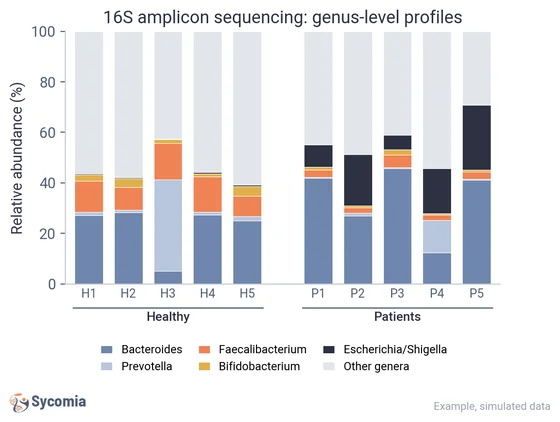
16S amplicon sequencing
Amplicon sequencing targets a marker gene, such as the 16S rRNA gene of bacteria, amplified from all the bacteria in a sample (gut, skin, soil, water…). It is a cost-effective way to describe which taxa are present, and in what relative proportion, across many samples.
Example analyses
- Quality control and primer trimmingRead quality checked and primers removed. Read pairs without primers are discarded, for consistent amplicons.
- Amplicon sequence variants (ASVs)Denoising with error models learned from your data: exact sequence variants, merged read pairs and chimera removal.
- Taxonomic assignmentClassification against curated reference databases, and removal of mitochondrial, chloroplast and unassigned sequences.
- Sequencing depthRarefaction curves to check that the depth of each sample is enough to capture its diversity.
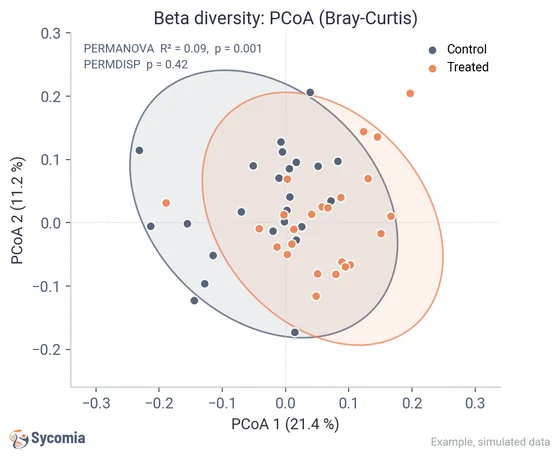
Diversity and differential abundance
Diversity analysis measures the diversity within each sample (alpha diversity: richness and evenness) and compares samples with each other (beta diversity). It shows whether your conditions change the microbiota, and how.
Example analyses
- Alpha diversityRichness, Shannon index, evenness and phylogenetic diversity, compared between groups with suitable statistical tests.
- Beta diversityBray-Curtis, Jaccard, UniFrac and Aitchison distances, shown by principal coordinates analysis (PCoA) and tested with PERMANOVA, with a check of the homogeneity of dispersions (PERMDISP).
- Differential abundanceIdentification of the taxa whose abundance differs between conditions, with methods suited to compositional data and adjustment for covariates (age, BMI, treatments).
- Composition and heatmapsRelative abundances from phylum to genus, and hierarchical clustering of samples and of the most abundant taxa.
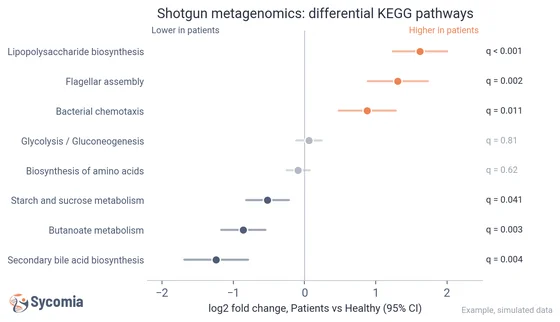
Shotgun metagenomics
Shotgun metagenomics sequences all the DNA in a sample, not just one marker gene. It reaches a finer taxonomic resolution, down to the species or even the strain, also detects archaea, fungi and viruses, and reveals the genes and metabolic pathways carried by the community.
Example analyses
- Taxonomic profilingIdentification and quantification of bacteria, archaea, fungi and viruses, down to the species, to describe community composition and diversity.
- Functional profilingIdentification of genes, pathways and functional modules to understand the metabolic potential of microbial communities.
- Comparison between conditionsTaxa and metabolic pathways compared between your groups, with the same statistical rigor as for 16S data.
- Host DNA removalHuman reads are removed before any analysis: a key step for biopsies or skin samples, which also limits the personal data kept.
Your analysis is not on the list? We also build custom analyses, tailored to your biological question. Let’s talk
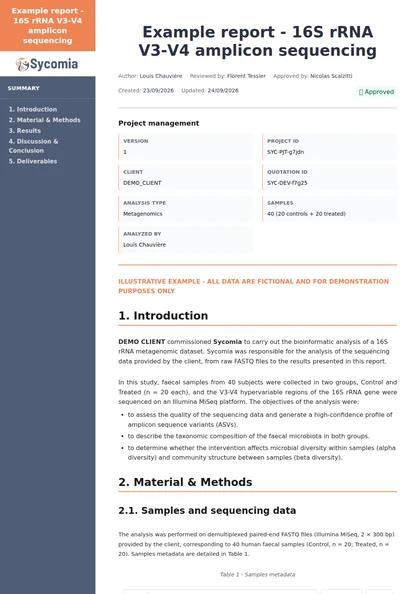
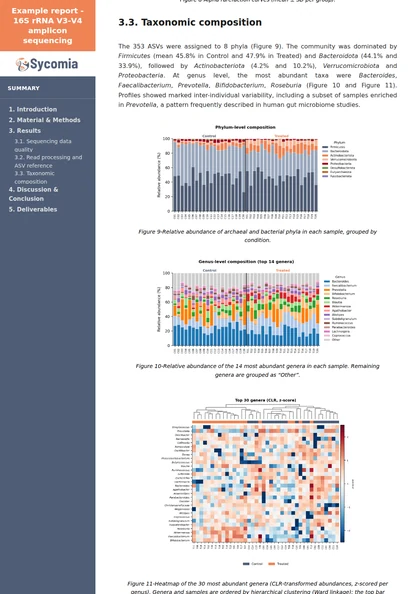
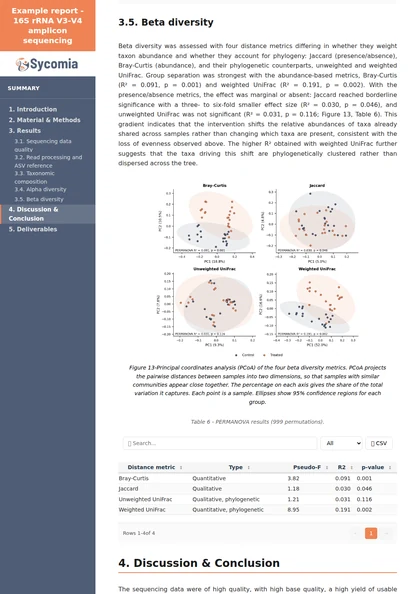
An example analysis report
What you receive at the end of your project.
- Quality controlThe quality of your data checked before any analysis, and its impact on the results.
- Complete resultsThe results of each analysis, with complete tables.
- Biological interpretationWhat your results mean for your biological question.
- Figures and filesPublication-ready figures and reusable files, in HTML or PDF.
16S metagenomics example on fictional data.
Frequently asked questions
Another question about your project? Write to us, an expert will answer.
Contact us16S or shotgun: which one should I choose?
16S amplicon sequencing is a cost-effective way to describe bacterial composition across many samples. Shotgun metagenomics costs more, but reaches the species level and reveals the functional potential of the community. We help you choose according to your question and your budget.
Which types of samples can you analyze?
Any microbial community: gut and stool, skin, mouth, soil, water, food or environmental samples. We work from your sequencing data (FASTQ files).
Do you provide an example of a metagenomics report?
Yes. View an example report of a 16S analysis, built on fictional data.
Is my data kept confidential?
Yes. We sign an NDA on request, before any exchange of data. Your data is processed on our own servers, clinical data is hosted in France by a certified health data host (HDS), and your data is deleted within 30 days of the end of the project, or earlier on request, in line with the GDPR.
Related services
Let’s talk about your metagenomics project
16S or shotgun, gut, environmental or food microbiota: tell us about your biological question and your data, and we will propose the right analysis strategy.