
Artificial intelligence for your biological data
For healthcare, research and the agri-food industry, Sycomia combines bioinformatics expertise with machine learning and deep learning to analyze complex biological data, and designs, develops and trains models tailored to your questions.
- machine learning
- deep learning
- LLM
- foundation models
- fine-tuning
- interpretability
// 01 Questions
The questions AI can answer
Artificial intelligence takes over when a biological question goes beyond the reach of a standard analysis. A few examples:
-
Q.01 Stratification
Are there distinct patient subgroups?
We look for patient subgroups in your omics (DNA, RNA, proteins) and clinical data without prior assumptions, then characterize what sets them apart.
-
Q.02 Biomarkers
Which signature separates my groups?
We identify robust molecular signatures linked to a disease, a treatment or a phenotype, including for agricultural selection.
-
Q.03 Annotation
What does this sequence do?
We predict the structural and functional annotation of genomic and protein sequences: genes, structure, functional sites.
-
Q.04 Prediction
Can we predict treatment response or another outcome?
We develop custom prediction and classification models from omics, clinical or contextual data, and evaluate them on independent data.
-
Q.05 Variants
Does this mutation have an effect?
We estimate the impact of a mutation on gene activity or protein stability, and its possible consequences.
Your project does not fit these boxes? We also design custom models for your question. Let’s talk
// 02 Foundation models
LLMs and foundation models
Trained on millions of sequences, cells or publications, foundation models learn the “language” of biology. We select them, adapt them to your data and build them into your analyses.
-
Proteins
Protein language models
Represent protein sequences, predict the effect of mutations, structure or function, and guide protein and peptide design.
-
DNA / genomes
Genomic models
Annotate genomes, predict regulatory elements, splice sites and transcription factor binding sites, and estimate the impact of non-coding variants on gene expression, from the DNA sequence alone.
-
Single-cell
Cellular foundation models
Annotate cell types, integrate datasets and explore the effect of perturbations from expression profiles, always benchmarked against simple baselines.
-
Text / literature
Large language models (LLMs)
Extract information from the literature and reports, structure metadata, build assistants that answer from your own documents.
What we can do
- EMBEDEmbeddings
Turn sequences, cells or texts into numerical representations your models can use.
- TUNEFine-tuning
Specialize a pre-trained model on your data and your question, with few annotated examples.
- RAGAssistants on your documents
LLMs that answer from your protocols, reports or publications, citing their sources.
- LOCALControlled deployment
Open-source models deployed on our servers, with our hosting provider in France or on yours, without ever sending your data to an external AI service.
// 03 Pipeline
From your data to explainable predictions
-
1. Your data
- Omics: DNA, RNA, proteins
- Clinical and contextual
- Checked and harmonized
-
2. The model
- Machine learning or deep learning
- Designed or adapted by fine-tuning
- Validated on independent data
-
3. The result
- Predictions and scores
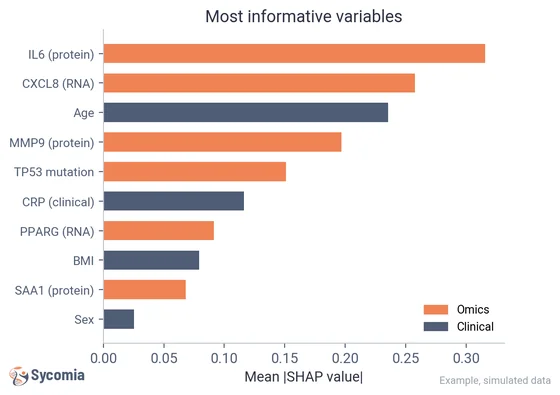
- The variables that matter
- A detailed report
$ sycomia-train --data omics+clinical --model neural-net --early-stopping
[data]   412 samples · 18 734 features · 2 classes
[split]  train 264 · validation 66 · test 82
[epoch 1] loss 0.68 · val_loss 0.71 · val_AUC 0.71
[epoch 2] loss 0.52 · val_loss 0.56 · val_AUC 0.80
[epoch 3] loss 0.43 · val_loss 0.48 · val_AUC 0.85
[epoch 4] loss 0.37 · val_loss 0.43 · val_AUC 0.88
[epoch 5] loss 0.33 · val_loss 0.41 · val_AUC 0.90
[epoch 6] loss 0.30 · val_loss 0.42 · val_AUC 0.89
[epoch 7] loss 0.28 · val_loss 0.44 · val_AUC 0.88
[epoch 8] loss 0.26 · val_loss 0.47 · val_AUC 0.87
[early stop] best epoch 5 · val_AUC 0.90
[baseline] elastic net · test AUC 0.86
[test]   evaluated once · AUC 0.91 [0.84, 0.96]
✓ Model validated: ready to be interpreted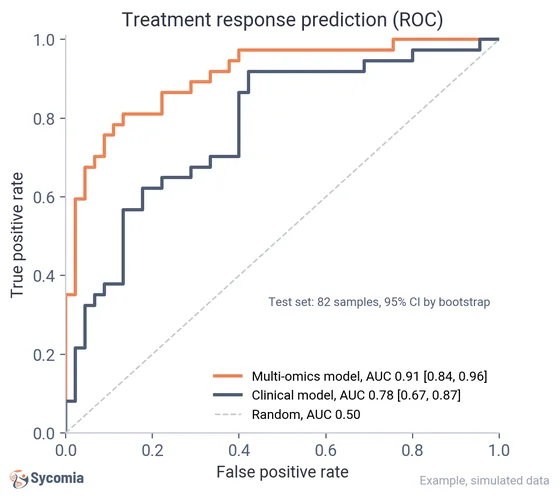
// 04 Method
How we work with you
A good model starts with clean data and a clear question. We build the model suited to your problem, train or adapt it to your data, and make its decisions interpretable.
- MOD.01
The right model for your data
The model is chosen according to the size and nature of your data, from linear models to deep learning: the simplest one that best answers the question.
- MOD.02
Rigorous validation
Nested cross-validation, external cohorts when available, comparison with simple baselines and no data leakage between training and test.
- MOD.03
Fine-tuning on your data
Adaptation of pre-trained models to your own dataset to improve accuracy and relevance while reducing training time and resources.
- MOD.04
Data engineering
Automated pipelines to collect, process and manage your data securely, with quality, consistency and traceability from source to model.
Frequently asked questions
Another question about your project? Write to us, an expert will answer.
Contact usDo you use LLMs and foundation models?
Yes. We use and adapt foundation models for proteins, genomes and single-cell data, as well as LLMs for the literature and your documents. Open-source models are deployed on our servers, with our hosting provider in France or on yours, without ever sending your data to an external AI service.
Which data can be used to build a model?
Omics data (DNA, RNA, proteomics), clinical data and contextual data. We help you assess whether your data is suited to your question before building a model.
Can you train a model on our own data?
Yes. We can develop a model from scratch or adapt a pre-trained model to your dataset through fine-tuning.
Which sectors do you work with?
Healthcare, academic and industrial research, and the agri-food industry.
Is my data kept confidential?
Yes. We sign an NDA on request, before any exchange of data. Your data is processed on our own servers, clinical data is hosted in France by a certified health data host (HDS), and your data is deleted within 30 days of the end of the project, or earlier on request, in line with the GDPR.
Related services
Let’s talk about your AI project
Tell us about your biological question and your data: we will help you assess what AI can bring and design the right model.